Beyond the Numbers: How South Africa Took the Lead in AI Search
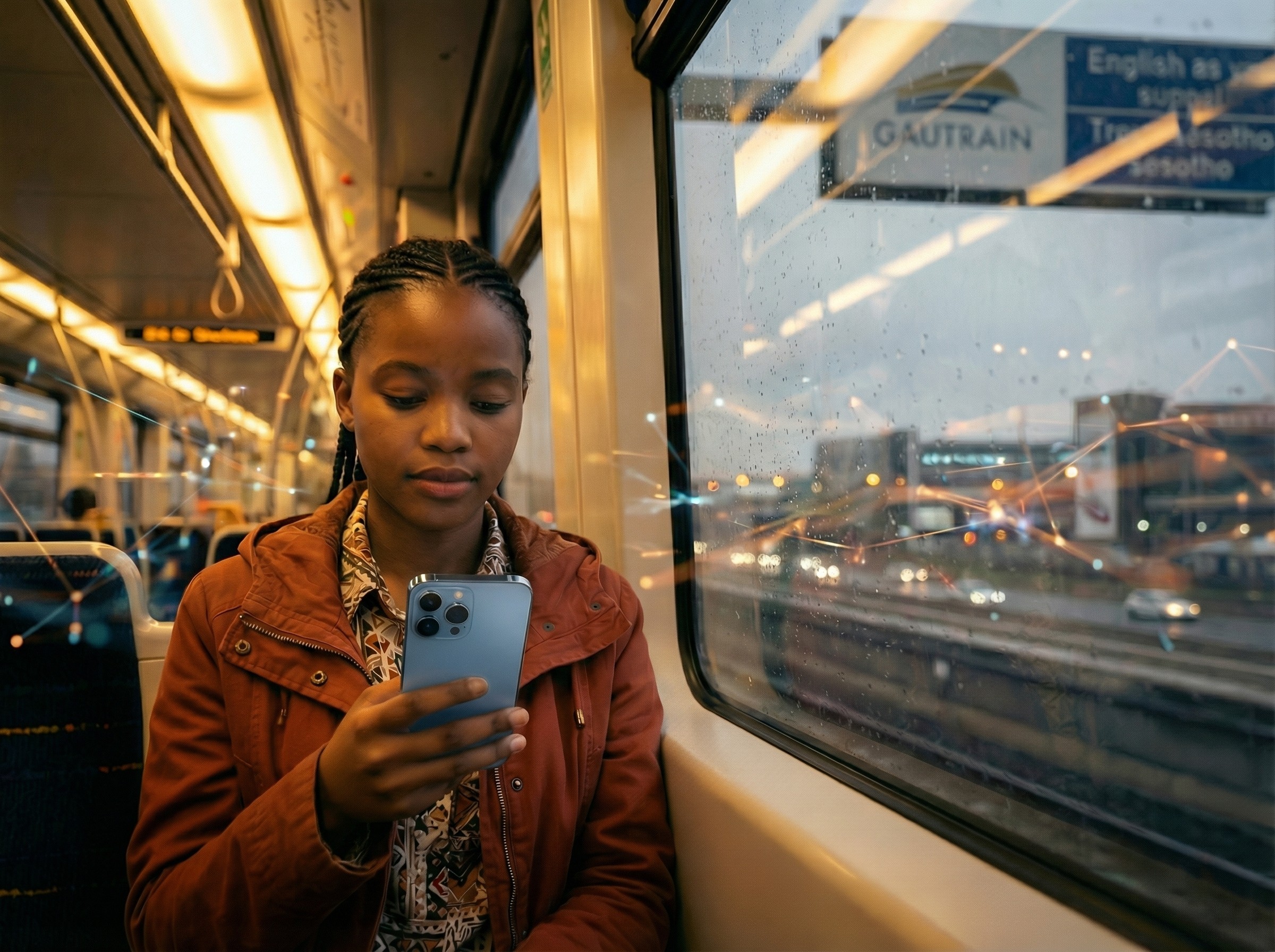
We South Africans have a knack for showing up just when things are about to get interesting. We’re not usually the ones shouting about it (unless the Springboks are involved…), but give us a breakthrough technology and apparently we’ll find a way to make it part of our daily lives faster than almost anyone else.
Case in point: AI-driven search.
Over the past year, we’ve turned to AI to answer questions, power businesses, and sharpen careers. If you want the short version: South Africa didn’t flirt with AI search; it put a ring on it. AI-related queries jumped 120% in a year.
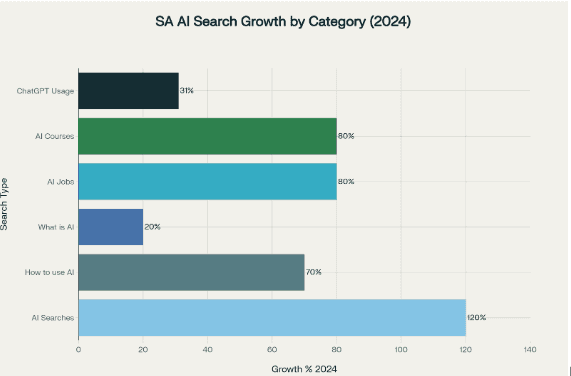
Here’s the bit that will surprise a few dinner-party experts: South Africa ranks 7th globally in ChatGPT usage, with roughly 31% of the population using it, which is a bigger base than most people assume. This is well ahead of many developed contries, who have better infrastructure and even bigger budgets.
We didn’t wait for permission to join the AI era. We simply logged in and got on with it. South Africa isn’t following global AI trends. We’re helping set them.
How We Accelerated the AI Search Revolution
If you want to understand why South Africa has sprinted ahead in AI search adoption, look no further than the thing we all carry everywhere: the smartphone. We’re a mobile-first nation, and that’s been a huge contribution to our success.
That mobile dominance pairs perfectly with conversational AI search. It’s faster. It’s easier. It lets us ask real questions without typing like we’re chiselling stone.
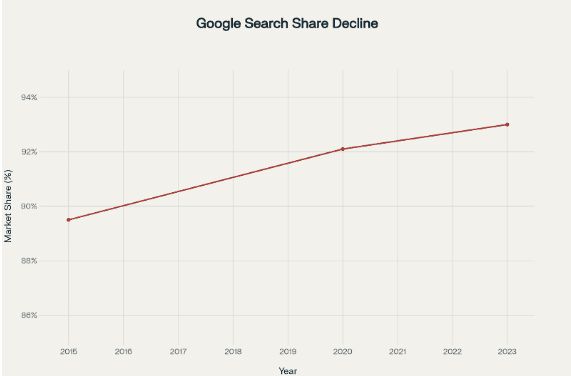
And South Africans are using this to get even more ahead of the curve. Searches for “how to use AI” jumped 70%, while job-related AI searches soared 80%. The shift is so pronounced that even the search giant is feeling it. Google’s market share dropped below 90% for the first time since 2015, while AI-powered alternatives have grabbed 5.8% of the global market, meaning users are choosing a new way to find information.
Quiet revolution? Maybe. Blistering pace? Definitely.
We didn’t wait to see where AI search was going, we just got there first.
How AI Search Is the New Competitive Edge for SA Businesses
South African businesses have never had the luxury of waste. When every rand counts and every kilowatt-hour is a coin toss, efficiency is survival. That’s why AI search tools have slipped so naturally into the country’s competitive strategy. Right now, 77% of local businesses are considered “AI-ready,” and more than half (51%) are already seeing clear benefits from implementation.
SMEs have been particularly cheeky here, using AI search to shrink the gap with bigger rivals. Market scans that used to take a week now take an afternoon, and the copywriting intern that you’ve shoved into the corner desk no longer has to pretend to enjoy manually compiling press releases.
To be clear, this is not something unique to us. The rest of the world is doing this too. 92% of Fortune 500 companies now use ChatGPT in some capacity. This is a trend that’s been mirrored locally as South African companies integrate AI into everyday workflows.
Here’s how this shift has surfaced:
Competitive intelligence compresses:
Scanning multiple markets, regulatory updates, and customer chatter now happens in hours, not days, which changes how often leaders can revisit assumptions without derailing everything else.
Marketing favours verifiable content:
AI engines quote and surface material they can trace back to credible sources, so substance and sourcing beat keyword karaoke (finally, some justice for the grown-ups in the room).
Operations get headroom:
Summarising, drafting, and comparing across sources creates time for judgement calls (the bit humans are still best at) while creating more consistent outputs across teams.
Skills at Warp Speed: The Skills Revolution in Real Time
Tools don’t create capability; people do. South Africans aren’t just using AI, we’re actively figuring out how to master it. And judging by our behaviour online, we’re doing so with the urgency of people who know the future won’t wait for us to catch our breath. South Africans are clearly busy: searches for AI courses and training have surged by 80%, making it one of the fastest-growing learning categories in the country.
It’s not just a niche tech crowd driving this: a remarkable 88% of South Africans want to learn more about AI. That level of public curiosity is a competitive advantage all by itself.
In classrooms and lecture halls, that shift is even sharper. Universities, colleges, and private academies are reporting unprecedented demand for curricula focused on AI. Not as a novelty, mind you, but as a core skill for employability.
We’re also seeing a generational tailwind. Over 45% of current AI tool users are under 25, meaning a digitally fluent workforce is already emerging. Expect adoption and proficiency to compound over the decade as today’s “early adopters” become tomorrow’s baseline.
The best part is that we’re doing it with optimism. Around 83% believe society will benefit from AI adoption, which feels like a rare statistic in a world where the future often feels like a villain-in-waiting.
The Friction Beneath the Momentum
Now, before we all start high-fiving our way into the AI hall of fame, we need to acknowledge the slightly flickering elephant in the room: not everyone can participate equally in this digital leap. Despite huge progress in connectivity, about 21.1% of South Africans (~13.6 million people) are still offline. That’s essentially an entire generation at risk of being left behind while the country (and the rest of the world) surges ahead.
And even for those online, access isn’t always reliable or affordable:
South Africa’s energy crisis means that things like load shedding continues to interrupt access to AI tools. This is especially true for people in rural areas.
Data costs still punish heavy usage for lower-income users, quietly discouraging intensity even among the connected.
Digital literacy gaps mean older and lower-income communities are slower to adopt new technologies, meaning the benefits skew toward people who were already running ahead, which is not the inclusive story anyone wants on the scoreboard in five years.
It’s a complex mix of infrastructure and inclusion. If we ignore these gaps, two futures emerge:
A highly skilled, globally competitive workforce emerges in connected areas
A digitally excluded population falls further behind each year
That widening divide is more than a tech challenge, it’s a national development challenge that we’ve been facing since long before the advent of AI.
We clearly have the curiosity, ambition, and adoption momentum to lead the continent. But unless access keeps pace with innovation, AI could deepen inequality as easily as it reduces it.
It’s undeniable that South Africa’s AI success story is already being written. The question is whether everyone gets to hold the pen.
What Will Tip the Balance: Our Chance to Build an Inclusive AI Future
If the past twelve months have proven anything, it’s that South Africans know how to make technology work for us, not the other way around. We’ve taken AI search from a novelty to a national advantage in record time. And the future’s only getting faster. The local AI market is projected to reach USD $1.65 billion by 2033, powered by our rapid digital adoption and a policy environment increasingly geared toward innovation.
But we also know this future isn’t guaranteed.
It depends on a few critical moves happening in sync:
Infrastructure that reaches rural communities as reliably as it reaches Sandton
Policy and investment that keep lowering data costs and raising digital access
Businesses shifting strategy to optimise for AI discovery rather than old-school search ranking alone
Education and training that ensure everyone (not just the early adopters) can benefit from
Because the bigger picture is that AI search represents more than efficiency, it represents equality of insight. When every entrepreneur, student, and worker can ask precise questions and get answers quickly, the entire economy moves faster, because knowledge stops being a luxury and starts being a shared national resource.
We’ve proved that we can lead. Now we get to prove we can lead together.
South Africa has momentum. We have ambition. We have talent. What we need next is to ensure that our AI-driven future is one where everyone gets a fair shot at progress, not just the connected few.
If we can solve that, the rest of the world should blink twice. Because we’ll be too busy building the future to notice them catching up.
Contact
Bring us what you’re seeing. We’ll show you what to do next.
Share a bit of context and what you’re trying to achieve. We’ll come back with the most useful next step and help you decide on the smallest set of moves that improves clarity, delivery, and measurement.