AI Search: What Every Business Leader Needs to Know
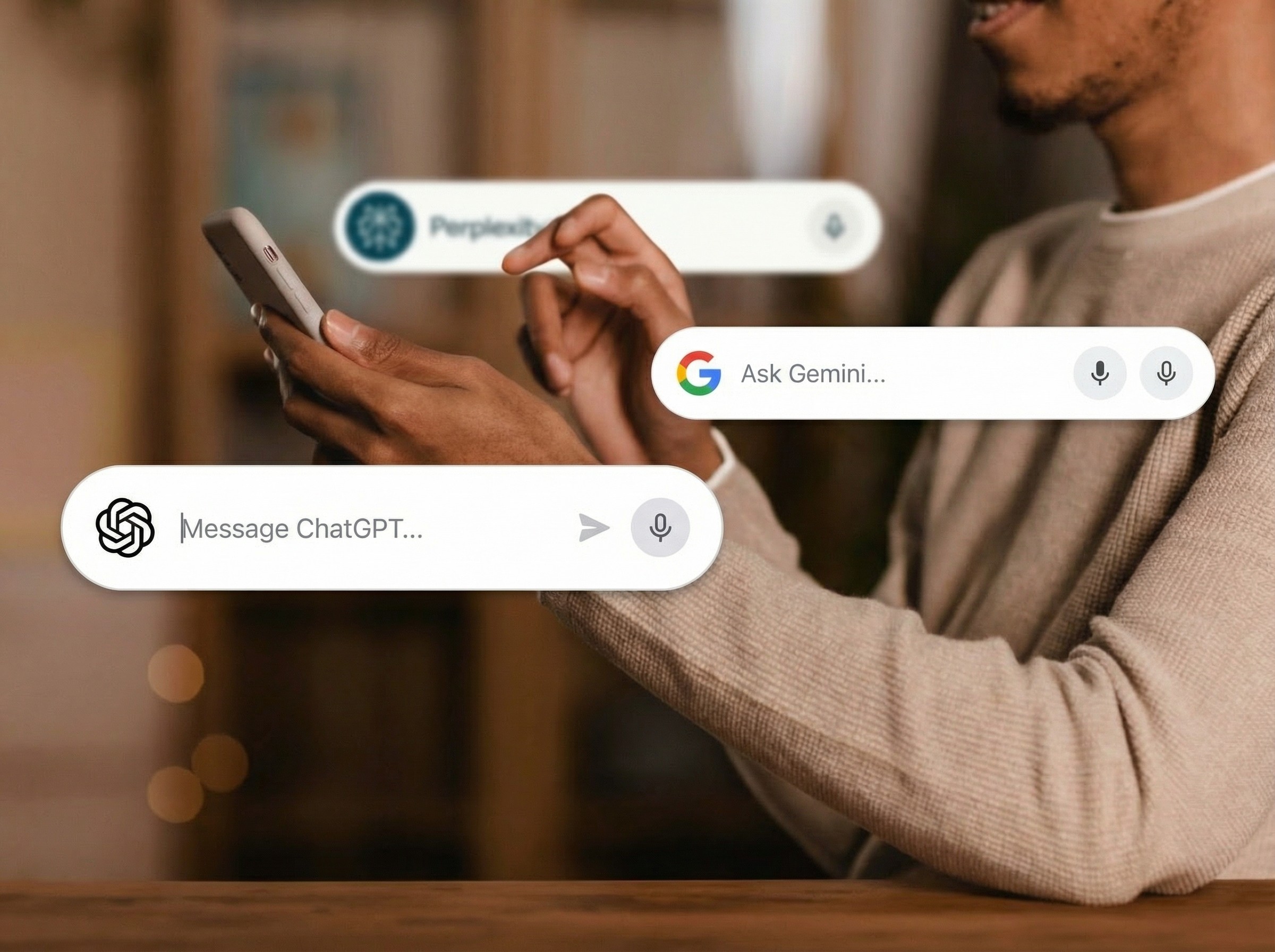
Since the advent and introduction of AI, the world of digital marketing has constantly shifted. AI has already changed the way people search, learn, and buy online. It’s not a future trend waiting to arrive. It’s here, and it’s reshaping digital marketing in real-time. For business leaders, the question is no longer if AI will disrupt your growth strategy. The real question is whether your business and your agency partners are adapting fast enough to stay ahead.
At Media Rocket, we’ve been living this shift. We’ve rebuilt our own growth strategies around AI. We’ve built and iterated again and again, refining our approach until we understood what actually drives results in this new landscape. This has given us a front-row seat to what works, what doesn’t, and where the real opportunities lie. Since then, we’ve been helping our clients make the same transition, keeping them ahead as AI reshapes the marketing landscape.
The biggest change that we’ve noticed is that the old rules are evolving. Search engines are becoming “answer engines”. Competitors are experimenting with AI-driven content, targeting, and personalisation at scale. While much of what worked in SEO still matters, Answer Engine Optimisation (AEO) takes those foundations further, demanding broader visibility, structured data, and authority across multiple platforms, not just Google. The gap between early adopters and everyone else is widening fast, and the data backs this up. The pace of adoption (and the scale of change) is clearer when you look at the numbers shaping this new reality.
The Numbers: Where the Market Is Already Moving
AI’s impact on marketing isn’t abstract anymore. We can measure it. We can track its adoption curve, its effect on customer behaviour, and its financial trajectory. And when you line up the numbers, they reveal a market moving much faster than most people realise.
Let’s break it down.
Adoption is already mainstream
78% of global companies are using AI today. Within the next three years, 92% expect to increase their investment. AI has moved from the margins to the core of strategy, budgets, and boardroom discussions.
For business leaders, this means the window of opportunity to catch the current wave is closing fast. Your competitors aren’t running pilots anymore. They’re embedding AI into their marketing funnels, customer experience solutions, and broader operations. The ones who started early already have the advantage of experience, iteration, and data maturity.
Customer behaviour has crossed the tipping point
ChatGPT alone has over 4.5 billion monthly users. That includes your customers researching products, your competitors exploring new strategies, and the talent you’ll need to hire next year.
The platforms shaping purchase decisions aren’t just Google and Facebook anymore. Customers now expect immediate answers, and they trust AI tools to give them those answers. The businesses showing up inside those answers will become the default choices for tomorrow’s buyers.
The search funnel is collapsing
Zero-click searches now account for almost 60% of all Google queries, up from 50% just a few years ago.
This is a profound shift. The old SEO model assumed a linear journey: rank high, attract clicks, drive traffic, convert customers. But if two-thirds of search journeys now end before a website visit, then visibility and influence are moving away from websites and towards the AI-driven platforms delivering the answers directly.
The money is following the trend
Global AI Search marketing revenue is projected to hit $43.63 billion in 2025. Budgets are moving away from traditional channels and towards the tools, data infrastructure, and expertise required to compete in an AI-driven landscape.
The companies making those investments early are buying speed, capability, and a competitive moat that late adopters will find hard to cross.
Why This Matters
These numbers are early indicators of a market rewriting its own rules in real time. For leaders, they highlight three critical truths:
AI is not a side project. It’s becoming the backbone of marketing strategy and customer engagement.
The window for catching up is shrinking. Early adopters are already compounding their advantage.
Old playbooks are breaking down. The metrics and models that worked five years ago won’t guide the next five.
The companies pulling ahead right now have something in common: they’ve stopped debating if AI matters and started building strategies and partnerships designed for this new reality.
And that brings us to the most important question: what exactly is changing inside the world of search, and how should leaders respond?
If your current agency or in-house team is still relying solely on the old SEO playbook, it’s time to rethink your approach.
What’s Actually Changing: Three Shifts You Can’t Ignore
The End of “Clicks” as We Know Them
Ranking at the top of Google used to be the ultimate goal. The formula was simple: higher rankings = more clicks = more traffic = more leads.
That model is collapsing.
With AI-powered “answer engines” like ChatGPT, Perplexity, and Google’s AI Overviews, people now get complete answers on the search page itself. No website visit required.
Two things change as a result:
Visibility moves upstream. It’s no longer about who gets the click; it’s about who becomes the source AI trusts enough to quote.
Traffic metrics lose meaning. If customers convert without visiting your site, pageviews and CTR stop being reliable success indicators.
This is where Answer Engine Optimisation (AEO) comes in, structuring content so it’s accurate, authoritative, and easy for AI systems to use as source material.
AI Users Are High-Intent Customers
AI adoption isn’t limited to tech enthusiasts anymore. Gen Z leads the way, with over 80% using AI search tools at least occasionally, and usage across other age groups is climbing fast.
What matters for marketing is this: AI search visitors convert 4.4 times better than traditional search visitors.
Why? Because people using AI search usually have a clear goal. They want answers, not options. By the time they reach a brand, they’ve already clarified their intent, making them far closer to a decision point.
This flips the traditional marketing funnel on its head. Instead of fighting for broad traffic at the top, the real advantage lies in high-intent visibility, showing up where AI platforms surface answers, recommendations, and solutions.
The Timeline for Change Is Shrinking
Forecasts suggest AI-driven search will overtake traditional SEO by 2028. But with Google, OpenAI, and others racing to make AI the default, that tipping point could arrive sooner.
Every quarter brings new features, new integrations, and new user behaviour patterns. Businesses that are moving early are already building experiences that others won’t be able to easily replicate later.
The Bottom Line
These changes have one thing in common: they reward early, informed action.
The brands investing in AEO now will be the default answers tomorrow.
Those showing up for high-intent customers will own the conversions.
The teams building AI capability today will be ready when traditional SEO finally tips into obsolescence.
And this is why your agency partner matters. You need people who are actually testing and delivering in this new environment, because waiting for a “perfect moment” to adapt is the fastest way to fall behind.
The Reality Check: Are You (and Your Agency) Ready?
The numbers make one thing clear: AI isn’t coming, it’s already here. But adoption and impact are two very different things.
Right now, only one in four businesses has moved beyond small-scale AI pilots to see measurable results. That leaves three out of four experimenting with tools, running proofs of concept, or waiting for the “right moment” to scale. All while their competitors are already capturing the early advantages.
Why the hesitation? A few patterns keep surfacing:
Skills gaps: Teams are unsure how to apply AI beyond basic automation or content generation.
Unclear strategies: Many businesses adopt AI tools without a clear roadmap for integration or measurable goals.
Lack of training: Staff often feel outpaced by the technology, creating resistance rather than confidence.
If your agency isn’t actively helping you close these gaps, you’re falling behind.
As AI reshapes how customers search, choose, and interact with brands, the companies that thrive will be the ones learning in real time, adapting quickly, and building AI capability into their day-to-day operations. That requires agency partners who aren’t stuck in “pilot mode” themselves, but who are already testing, refining, and scaling AI-driven strategies with real-world clients. This is where the divide between early adopters and everyone else starts to widen, not because the technology isn’t available, but because too many teams are waiting for certainty in a market that rewards speed, learning, and iteration.
The Playbook: How to Build for an AI-First Search World
Moving beyond pilots and experiments demands a structured approach that combines the right strategy, the right people, and the right partnerships. Here’s how to move from curiosity to capability.
Step 1: Assess Your Agency’s AI Readiness
Before you can adapt, you need to know whether the people advising you are ready themselves. Ask the hard questions:
Are they using AI with real clients today? Look for evidence of tools, pilots, and campaigns in action.
Are they investing in skills and training? AI isn’t a one-and-done capability. The best agencies are teaching their teams (and their clients’ teams) how to use these tools effectively.
Can they prove impact? It’s not enough to say “we use AI.” Your agency should be able to show you how AI improves ROI, lead quality, and customer experience with hard data.
If they can’t answer these questions clearly, you have your answer.
Step 2: Rethink Your Content and SEO Strategy
The old playbook focused on keywords, rankings, and clicks. The new one focuses on visibility in AI-driven answers.
Move beyond keywords. Focus on content that directly answers customer questions and is optimised for AI search and answer engines.
Embrace Answer Engine Optimisation (AEO). Use structured data and authoritative information that AI can easily cite.
Think multi-platform. Your agency should ensure your brand is visible not just on Google, but on ChatGPT, Perplexity, and other emerging AI platforms.
Step 3: Invest in People and Partnerships
AI doesn’t replace people. It changes what people can do. These are steps that you can take to enhance your team’s capabilities when working with AI:
Upskill your teams. Marketing, sales, and content teams need to know how to use AI to work faster, test ideas, and measure impact.
Choose AI-first agency partners. The right agency brings specialists, pilots new tools, and helps you adapt before trends hit the mainstream.
Build an AI-ready culture. Encourage experimentation, reward learning, and make it safe to try things that might not work the first time.
Step 4: Track the Metrics That Matter
Traditional metrics like traffic volume are becoming less useful as AI search grows. Focus on what actually drives growth:
Lead quality and conversion rates. AI search visitors convert better. Measure that difference.
Share of voice in AI platforms. Are you the brand being cited in AI answers?
Customer satisfaction and engagement. Track whether AI-driven interactions improve the user experience, not just the click-through rate.
The goal isn’t to collect more data, it’s to collect the right data so that you can make better decisions, faster.
Competitive Advantage: Why Acting Now Matters
Businesses already integrating AI into their search, content, and marketing strategies are seeing:
10–20% higher sales ROI within the first year
Faster revenue growth from better-targeted campaigns and higher-intent leads
Stronger customer loyalty driven by more personalised, timely interactions
What sets these businesses apart is the speed at which they’re learning, refining, and scaling AI-driven approaches while competitors stay in “planning mode.”
Acting early compounds your advantage in three ways:
Data maturity. The sooner you start, the more historical data you have to train models, test campaigns, and improve performance. Late adopters will be starting from zero while you’re optimising version five.
Process integration. Early adopters figure out where AI fits into workflows, content pipelines, and customer touchpoints long before others do. That learning curve is steep and time-consuming.
Market presence. In AI-driven search, the brands that show up first become the defaults customers (and algorithms) recognise. Once established, that visibility is hard to displace.
The lesson is simple: AI rewards speed, iteration, and real-world application. Waiting for a perfect strategy means handing your competitors months of lead time that they won’t give back.
Industry Snapshots: Where AI Adoption Is Moving Fastest
Some industries are already seeing measurable impact. A few examples stand out:
Retail & E-commerce
AI-powered chatbots and recommendation engines are transforming online sales. Retailers using AI for customer support and product suggestions report up to 67% higher sales and faster response times for customer queries.
B2B & Professional Services
In sectors where sales cycles are long and complex, AI is automating early-stage lead qualification and follow-up. This frees sales teams to focus on higher-value conversations instead of repetitive outreach. Companies adopting AI here are reporting shorter deal cycles and higher-quality leads, thanks to smarter targeting and faster response times.
Healthcare & Financial Services
Two industries known for information complexity are using AI to simplify decision-making. These sectors are using automation and data analysis to deliver faster, more accurate answers to people making high-stakes decisions. The result? Improved customer trust and reduced operational costs.
The Future Is Conversational
The way people interact with brands is about to change more in the next five years than it has in the last fifteen. By 2028, AI-driven interfaces (including voice, chat, even interactive video) will handle a growing share of customer research, product discovery, and support. Customers will expect conversational, accurate, personalised answers wherever they are, on whatever platform they’re using.
This means two things:
Being the answer matters more than owning the channel. If a customer gets what they need inside ChatGPT, Perplexity, or a voice assistant, the website visit becomes secondary. What matters is whether your brand is the one delivering the answer.
Customer experience shifts upstream. Conversations powered by AI shape trust, brand perception, and buying decisions long before someone speaks to a human or clicks a “buy” button.
The brands preparing for this future are already experimenting with AI-powered chat interfaces, conversational commerce, and answer-first content strategies so that when customer expectations change, they’re not scrambling to catch up.
Lead the Change Before It Leaves You Behind
AI-driven search is already reshaping how customers find, choose, and interact with brands. The businesses pulling ahead are the ones learning faster, experimenting earlier, and building the right partnerships to navigate a changing landscape.
The choice is simple: adapt now or play catch-up later.
In an AI-first world, experience and execution matter more than theory.
At Media Rocket, we’ve lived this shift ourselves, and we now help our clients do the same. We know what works, what doesn’t, and how to move quickly without the guesswork.
If you’re ready to stop debating and start building for the future, let’s talk.
References
Contact
Bring us what you’re seeing. We’ll show you what to do next.
Share a bit of context and what you’re trying to achieve. We’ll come back with the most useful next step and help you decide on the smallest set of moves that improves clarity, delivery, and measurement.